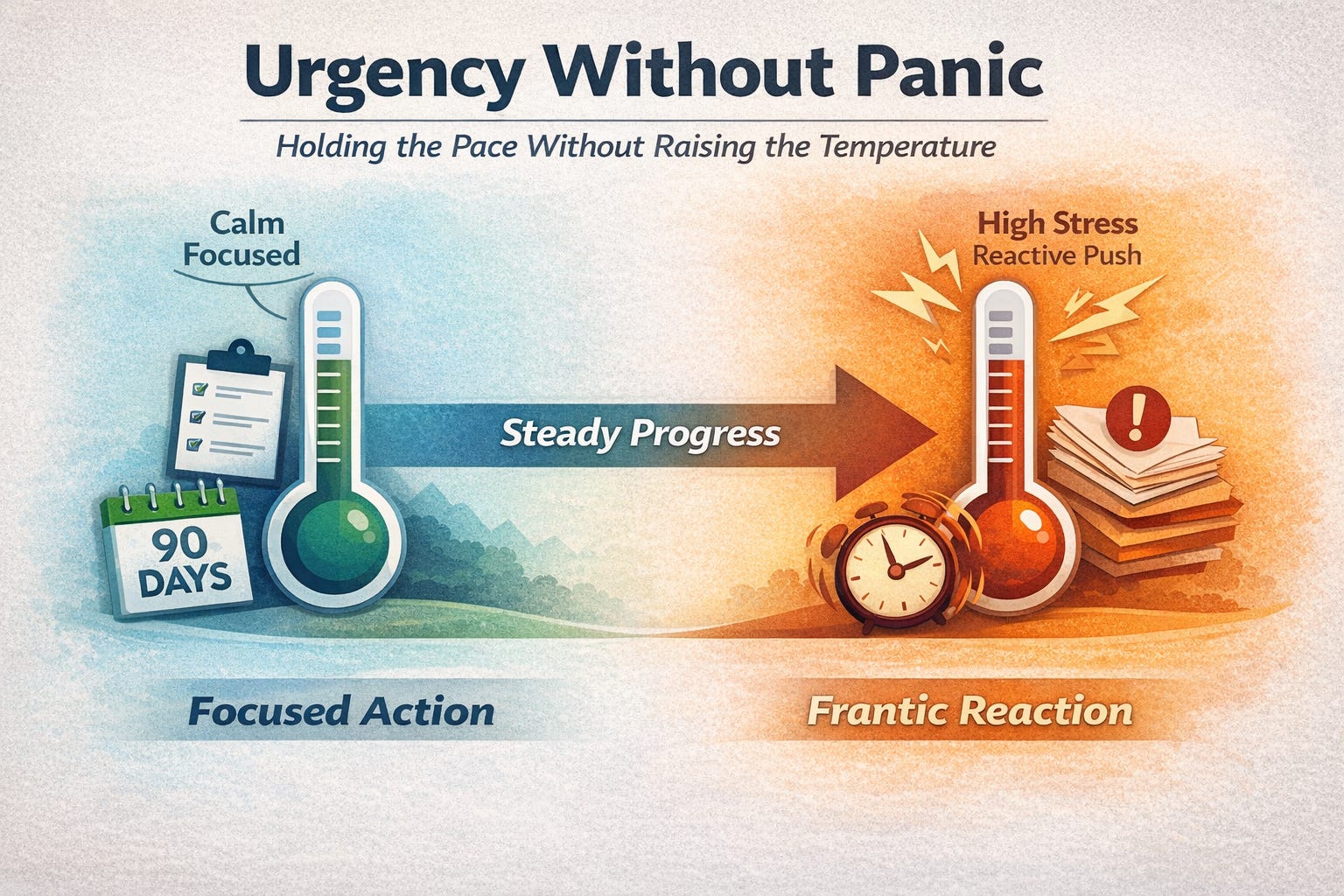
Urgency Without Panic
Holding the Pace Without Raising the Temperature

Urgency is not the same thing as anxiety. Yet in schools, the two are often confused.
When leaders feel pressure, whether from data, timelines, or external accountability, that pressure can quickly leak into the system. Meetings speed up and decisions compress. Communication becomes reactive. The pace increases, but clarity decreases. What was intended as urgency begins to feel like panic.
Teachers notice the difference immediately.
Productive urgency creates focus. Panic creates noise.
Urgency without panic is a leadership discipline. It is the ability to move decisively without destabilizing the people doing the work. It is central to effective 90-day cycles because short timelines demand momentum, but momentum only sustains when people feel grounded.
Urgency answers the question, “What matters most right now?” Panic answers the question, “What can we fix the fastest?” Those are not the same.
Reactive leadership often shows up as a flurry of initiatives, emergency meetings, or sudden shifts in expectations. None of these are inherently bad, but when they are not anchored to a clearly defined problem of practice, they signal uncertainty rather than direction. Teachers experience this as whiplash. The work feels urgent, but not purposeful.
In contrast, productive urgency is precise. It is rooted in diagnosis. It comes from having named the student learning problem clearly, identified a narrow adult practice to improve, and committed to studying the impact over a defined window of time. That precision is what allows leaders to say no to distractions and yes to depth.
This is where the 90-day cycle matters.
The power of a 90-day plan is not speed for speed’s sake. It is bounded urgency. The timeline is short enough to prevent drift, but long enough to allow learning. Leaders do not need to manufacture pressure because the structure already provides it. The work feels important without feeling frantic.
Urgency Without Panic sounds like this:
• “This is our focus for the next 90 days.”
• “We are not solving everything at once.”
• “We will learn from this cycle and adjust.”
Panic sounds like:
• “We have to fix this now.”
• “Let’s try all of these strategies at once.”
• “We cannot afford to slow down.”
Ironically, panic slows improvement. When people feel rushed, they default to surface-level compliance. They do the work to survive the moment, not to change practice. Urgency without panic, on the other hand, creates psychological safety. Teachers can take risks because the expectations are clear and the scope is contained.
When leaders hold urgency with steadiness, they send a powerful message. Your work is important enough to deserve focus, clarity, and time. Teachers are not asked to sprint endlessly. They are invited into a disciplined cycle of improvement where their effort is visible and their learning counts.
Leadership is not about removing pressure. Schools operate in real constraints. But leadership is about regulating pressure so it sharpens thinking rather than erodes it.
The most effective leaders do not eliminate urgency. They translate it. They turn external pressure into internal coherence. They replace panic with purpose.
That is how urgency becomes a catalyst rather than a cost.
Visit: https://www.matteringk12.com/